Updates (January 2026 to March 2026)
March 2026 — Updated the topic to add information about the dynamic match for the payload section. For more information, see Understand Payload Match.
Enumeration is a method attackers use to test APIs with numerous distinct values, such as usernames or object identifiers, to determine which ones are valid. This technique is commonly used to discover sensitive records or confirm the existence of accounts. Traceable detects such patterns by tracking the volume of unique values submitted within a specified time window. When the defined limit is exceeded, Traceable can raise an event, continue monitoring, or enforce blocking based on the configured rule. This protection helps limit large-scale data discovery attempts and reduces the risk of unauthorized disclosure.
What will you learn in this topic?
By the end of this topic, you will be able to:
Understand how Enumeration Attacks work.
Understand how to configure an enumeration rule.
Understand how to define detection conditions based on API behavior.
Understand how to apply actions to monitor or block suspicious activity.
Understand Enumeration
Before you configure enumeration rules, it is essential to understand how attackers probe APIs by sending a large number of unique inputs, such as usernames and email addresses, to identify valid data. Even when individual requests appear harmless, this pattern allows attackers to gradually discover accounts and sensitive records. Traceable detects this behavior by tracking how quickly unique values appear in API traffic and flags activity that deviates from normal usage. The table below explains when to use enumeration protection, why it matters, and how to apply it effectively.
Why use it? | When to use? | How can you leverage it? |
|---|---|---|
Prevents attackers from discovering valid users, accounts, or records through repeated probing. Helps reduce data exposure, credential harvesting, and misuse of sensitive endpoints while improving signal quality by filtering noisy traffic. | Use enumeration rules for APIs that accept user-controlled inputs and return existence-based or sensitive responses. This includes login, signup, password reset, account lookup, search, and ID-based retrieval endpoints. | Create a rule by defining the intent, source conditions, payload criteria, and target endpoints. Configure thresholds for unique values and time range, choose how to evaluate activity (per user or across users and endpoints), and select an enforcement action. |
Before you begin
Before you proceed to create the rules, it is important to understand how payload match works.
Understand payload match
Before creating the rules, it is essential to understand payload match, as described in the subsequent sections of Steps to Create a Rule. Traceable supports two types of payload match when evaluating rule criteria:
Static Payload match (default)
In Step 1 of rule creation, Traceable uses payload match to evaluate request and response data against defined rule criteria. In a static payload match, Traceable compares a selected request or response component against a fixed Value to determine whether a rule condition is met. If you do not enable the Dynamic toggle, it compares a static component against a static value. You must configure the following elements:
Element
Description
Component
The part of the Request or Response to evaluate, for example, Header.
Operator
The comparison logic used to evaluate the component against a specified value, for example, Matches exactly.
Value
The fixed value used for comparison, for example, /login.
In this example, the selected attribute, Request URL, matches the value /login.
.png)
Static Matching
Dynamic payload match
In Step 1 of rule creation, Traceable supports dynamic payload match for the Request, Response, or Attribute criteria field. Dynamic matching allows Traceable to compare two attributes rather than matching a component against a static value. Each side of the comparison can reference values from the request, response, or extracted attributes. The following table displays the different elements, their descriptions, and examples involved in payload match:
Element
Description
Example
First Component
The first attribute selected for comparison. You can choose a value from the Request, Response, or Attributes.
Request Header:
AuthorizationOperator
The comparison logic is used to evaluate the relationship between the two selected components.
Matches exactly
Second Component
The second attribute selected for comparison from the Request, Response, or Attributes. Traceable dynamically resolves both values during request processing.
Request Header:
x-auth-tokenSample Scenarios
The following sample use-cases show different options available, giving you the flexibility to compare different attributes dynamically:
Scenario 1 — Compares selected request header values to validate consistency
For certain components, Traceable supports value-to-value comparisons within the same request context. In these cases, Traceable first evaluates each component independently at a granular level and then dynamically compares the resolved values. For example, the header component takes Authorization and x-auth-token request header values and compares them for each incoming API request, as shown below:
.png)
Dynamic Match
Scenario 2 — Compares two attributes from the request, response, or extracted attributes to evaluate whether their values match dynamically
For some components, you can compare the Request URL with the attribute component with the value to match a pattern. The screenshot shows a dynamic payload match configured for the Request URL attribute. In this example, the rule evaluates the Request URL and matches it against the pattern /login to identify requests targeting the login endpoint. You can also compare the Request URL with the attribute component with the value to match a pattern, as shown below:
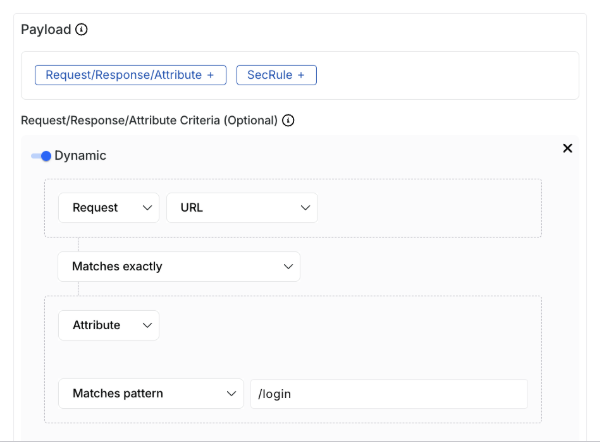
Dynamic Match
The following interactive demo walks you through the steps to dynamically match payloads in the criteria step of rule creation, if you select request, response, or attribute criteria in the payload:
Steps to create a rule
You can configure an enumeration rule to detect and prevent abuse patterns such as credential stuffing or data harvesting by monitoring API activity. These rules help protect sensitive data and prevent unauthorized access by identifying abnormal input patterns. To create an enumeration rule in Traceable, navigate to Protection → Settings → Policies → Custom Policies, open the Enumeration tab, and click + Add Rule. Complete the following steps:
Set the Criteria — Define where and how the rule applies by configuring the source, payload conditions, and target API scope.
Configure the Conditions — Specify thresholds such as unique values, time range, and evaluation scope to detect enumeration behavior.
Configure the Actions — Choose how Traceable should respond when the rule is triggered, such as blocking or monitoring traffic.
Review and Submit — Validate the configuration and activate the rule to enforce protection.
Step 1 — Set the criteria
As part of setting up the criteria, you must complete the following:
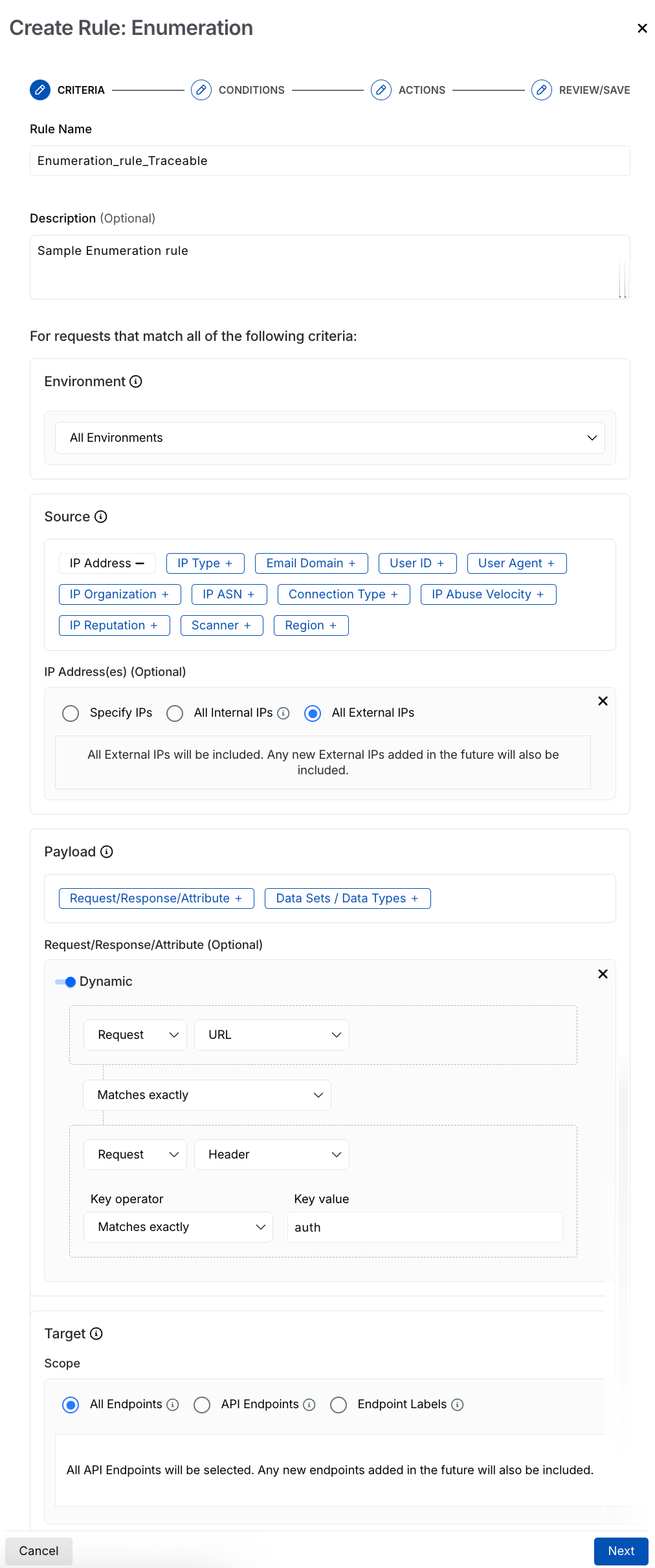
Create Enumeration Rule
Rule Name — Specify a unique and identifiable name for the rule.
Description (Optional) — Provide a summary of the rule, for example, the type of threat it is designed to block.
Environment — Select the environment where Traceable should apply the rule according to your requirements.
Source Criteria — Define the traffic conditions on which the rule applies, for example, Region → Afghanistan. Traceable supports the following sources for creating an enumeration rule.
Category
Source
Description
IP-based
IP Address
Match traffic from specific internal or external IPs.
IP Type
Identify traffic from VPNs, bots, scanners, or proxies.
IP Organization
Filter traffic from known organizations that generate high request volumes.
IP ASN
Match traffic based on network provider (ASN).
IP Abuse Velocity
Detect IPs with high API abuse rates.
IP Reputation
Filter IPs flagged as high-risk by threat intelligence.
User-based
User ID
Match specific users or patterns using regex.
User Agent
Identify clients, such as browsers, bots, or scripts, using regular expressions.
Email-based
Email Domain
Match requests from specific or grouped email domains.
Network context
Connection Type
Filter traffic from corporate or data center networks.
Automation
Scanner
Detect traffic from automated testing or scanning tools.
Geographic
Region
Apply rules based on country or geographic location.
Note
All Sources, except IP Abuse Velocity and IP Reputation, have an Exclude checkbox corresponding to their value field. When you select that check box, Traceable applies the policy to all values except the ones you choose.
Payload — The payload on which you want to apply the rule. You can create the rule based on the following:
Payload options
Field
Description
Request / Response/Attributes
API Interaction
Select whether the rule applies to a request or response.
Component
Select API components such as URL, headers, or body.
Operator
Define the comparison logic (for example, contains, equals).
Value
Specify the value to match (for example,
accounts).Key
Select the attribute and operator (for example,
authorizationwith exact match).Value
Define the value for the selected key. Defaults to Any Value, but you can refine it. However, you can select a different one from the drop-down and specify the value accordingly. For more information, see Understand Payload Match.
Data Sets or Data Types
Data Location
Specify where Traceable identifies the data (for example, request body).
Datasets or Datatypes
Select classified data types or datasets for rule evaluation. For more information, see Data Classification.
Target — The API endpoints you want Traceable to monitor under this rule. You can select one or more APIs or labels to which the rules should apply. The rule applies to all the underlying APIs when you select a label.
Once you have set the above criteria, click Next.
Step 2 — Configure the conditions
Define when the rule should trigger by setting limits on unique values and choosing how Traceable evaluates activity across users and endpoints. These settings help you detect abnormal patterns and differentiate enumeration behavior from normal API traffic. Use the following options to configure these thresholds and evaluation criteria.
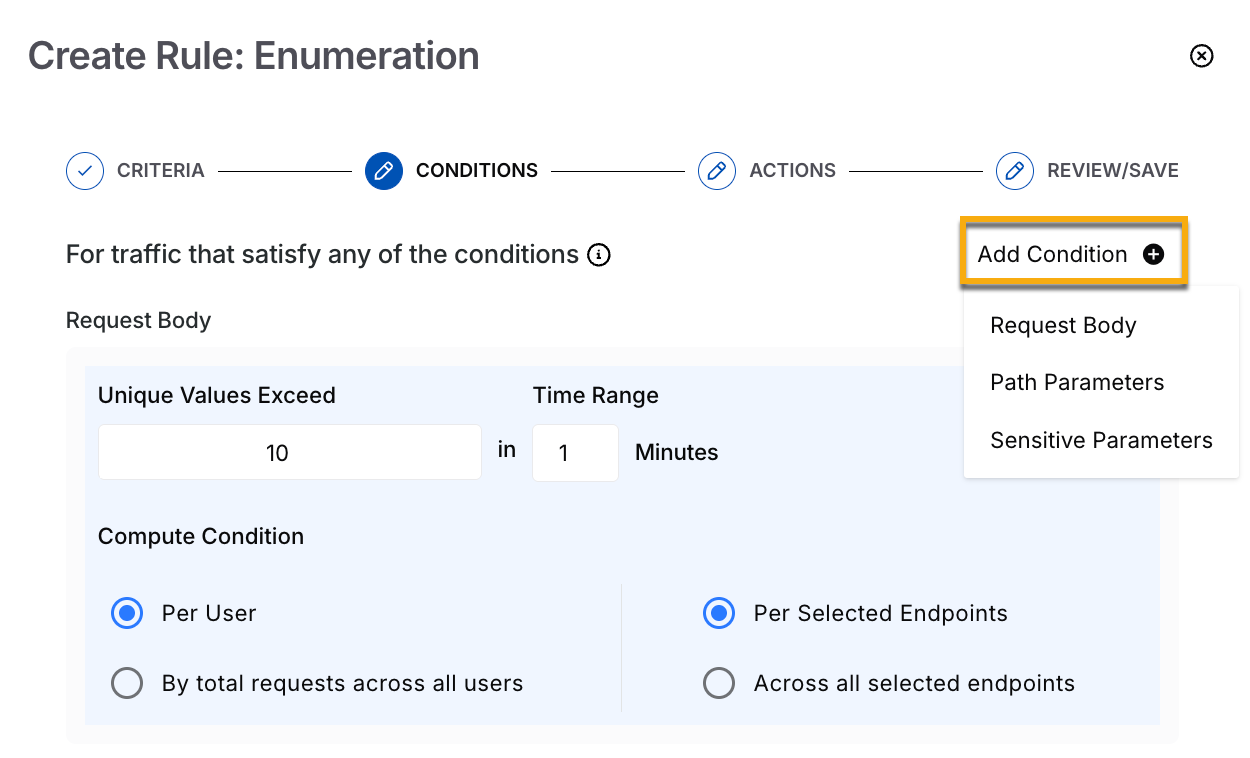
Enumeration Conditions
Request scope — Apply these conditions to specific parts of the API request:
Request Body — Evaluate values in the request payload.
Path Parameters — Evaluate dynamic values in the URL path.
Sensitive Parameters — Evaluate classified or sensitive inputs.
Enumeration condition parameters — You can use these parameters to control when the rule triggers:
Parameter
Description
Example
Unique Values Exceed
Sets the maximum number of distinct inputs (such as usernames, emails, or IDs) allowed within the defined time window before Traceable triggers the rule.
10 unique usernames
Time Range
Defines the time window during which Traceable tracks and evaluates unique values.
10 unique values within 5 minutes
Defines how Traceable evaluates activity by combining who generates the traffic and where it occurs.
Per user across all endpoints
Compute condition options — You can use compute conditions to control how Traceable evaluates activity across users and endpoints.
Scope
Evaluation
Description
Example
Per user
Per endpoint
Evaluates each user independently for each endpoint. Triggers the action when a user exceeds the limit on a specific endpoint.
If a user submits 12 unique usernames to
/loginand the configured limit is 10, Traceable triggers the configured action for that user.Per user
Across all endpoints
Evaluates each user across all selected endpoints combined. Triggers the action when a user exceeds the total limit.
If a user submits values across
/loginand/reset-passwordthat exceed the combined limit, Traceable triggers the configured action.All users (aggregate)
Per endpoint
Evaluates the combined activity from all users on each endpoint. Triggers the action when total activity exceeds the limit.
If five users each send 20 unique values to
/searchWithin one minute, and the combined activity exceeds the configured limit, Traceable triggers the configured action for all users.All users (aggregate)
Across all endpoints
Evaluates total activity across all users and endpoints. Triggers the action when overall activity exceeds the limit.
If combined traffic to
/loginand/signupexceeds the configured threshold, Traceable triggers the action globally for all users.
Step 3 — Configure the actions
As part of configuring the action, you must complete the following:
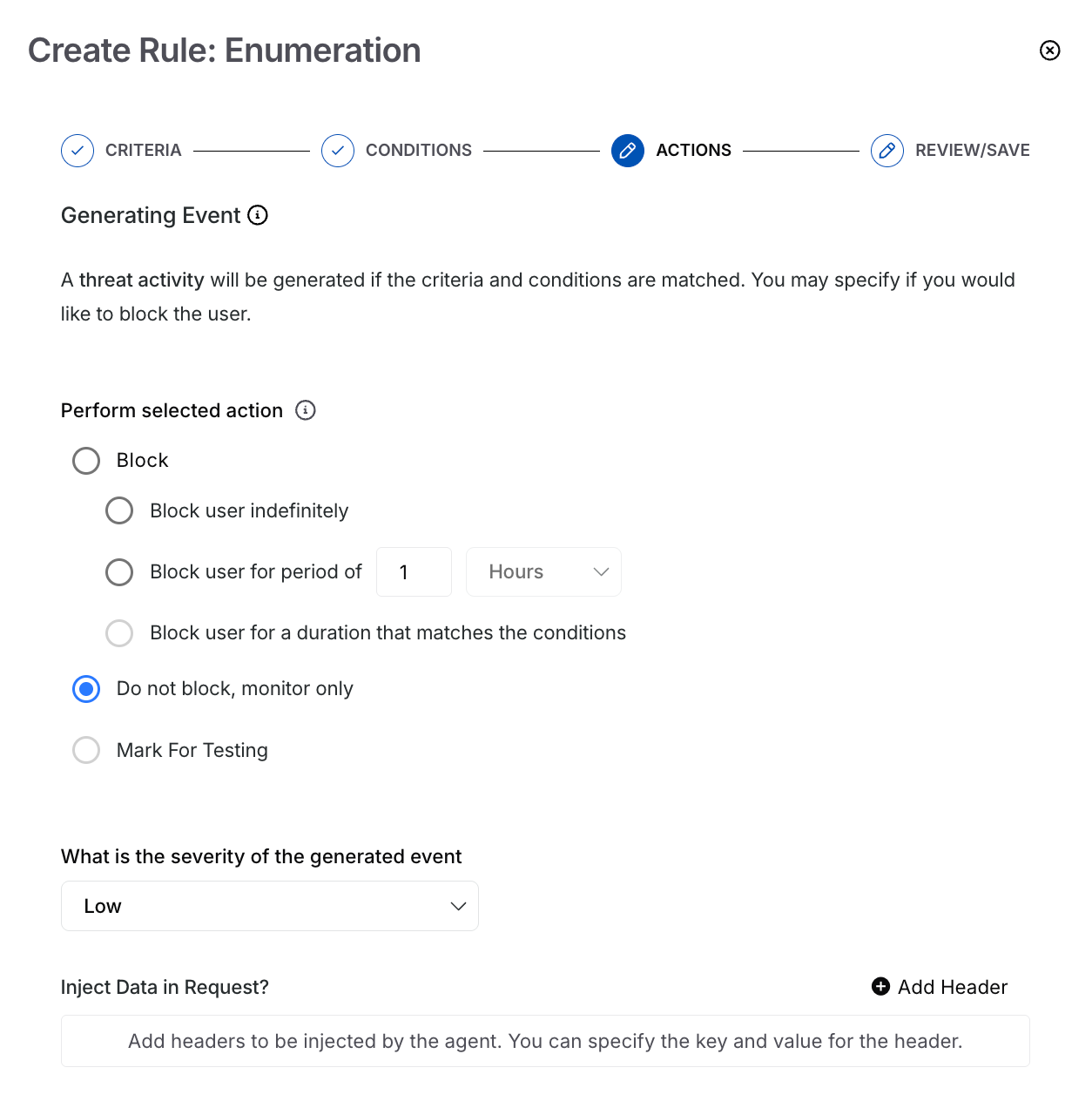
Enumeration Actions
Perform selected action — Traceable provides the following options for handling the event generated by the enumeration rule. The options let you verify your rule, observe the generated events, and then block requests as needed. The following table describes the available event handling options and how Traceable responds when the rule conditions are met.
Option
Description
Block indefinitely
Permanently blocks the user when they meet the defined criteria. Prevents all further API requests.
Block for a fixed duration
Blocks the user for a duration you specify after they meet the criteria.
Block based on condition duration
Blocks the user for the same duration as the configured time range in the rule conditions.
Monitor only (Do not block)
Does not block the user. Continues to monitor activity and generates events.
Mark for Testing
Tests the rule without impact. Generates low-severity events and does not send notifications. View these events in Protection → Threat Activity using the Testing filter.
Severity of the generated event — Select the severity level for the generated event Low, Medium, High, and Critical. By default, Traceable assigns Low severity to the event.
Note
This option is available for all options except Mark for Testing above.
Data Injection — Add custom data to the request header to include additional context. Use this to monitor and highlight anomalies in requests.
Note
This option is available only when you select the Do not block, monitor only or Mark for Testing options above.
Once you have configured the above, click Next.
Step 4 — Review and submit
In the final step, review and submit the rule. If you wish to edit any criteria during the review, click the Edit ( ) icon corresponding to a section.